Monday, September 1, 2014

Challenge Accepted: the 30 Day Teacher Blogging Challenge


Taking the Challenge! Meg and I have decided to take the 30 Day Blogging Challenge posted by Te@chThought.com.  The challenge asks teachers to blog during the 30 days of September with the goal of becoming a more reflective teacher.  Each day a prompt is given to guide you in the blogging process.  It can’t get any easier than that, right?  So,  see the link below and join us in this great opportunity to become better at our craft--teaching!.


Day 1 of the challenge:

Write your goals for the school year. Be as specific or abstract as you’d like to be!
Jamie-As I start my 21st year in the classroom, I continue to struggle with implementing the readers and writers workshop philosophy into my middle school English classroom.  Trying to fit time to teach mini-lessons, for students to write, and me to conference all in a 45 minute class period can be very difficult.   It is also very hard to maintain conferences over 5 class periods with over a 100 students. So, this is definitely something I am working on improving.  Secondly, I want to work on being more consistent in maintaining my word wall.  I always start off strong, and then by mid-year I taper off. One last goal would be to also work on maintaining my “Bell Ringers”.  I love to have something for students to complete as they enter my classroom.  However, once again, I start the year off strong with fun and interesting prompts, and then it somehow dwindles.  If I could improve on these three things, it would be quite an accomplishments.  Here’s to another year of trying!

Meg-I have transitioned back to teaching sixth grade this year, and in just the two short years of teaching eighth grade it was easy for me to forget how many differences there are between these two ages of students! In light of this, one of my goals is to provide structures for my sixth grade students that will promote self-sufficiency. In order to do that, I am attempting to use my class website a bit differently this year than I have in the past. The sixth graders are piloting iPads, and I want them to use these iPads to help them self-start at the beginning of class. As a part of our daily routine, I am having the students first go to my class website on their iPad where they will find the supplies needed for class, the essential questions for the day, directions for stations (if we are doing stations that day in class), as well as the homework assignment for the night. Hopefully this will be a helpful resource that will support students in being more self sufficient. Another goal of mine, similar to Jamie's, is maintaining consistency with using a math workshop approach in my classroom. Although it may not be something I use every day, I do want to use this model on a regular basis to provide a good balance of instruction, remediation, and independent work time that is more tailored to the needs of each student.

Thursday, August 14, 2014

It's Story Time in Math Class!

Jamie & me at my wedding!
This has been an exciting summer for the both of us to say the least.  The weeks have flown by, overflowing with vacations, weddings, gatherings with friends and family, and teaching our beloved MLIT students at Judson University.  And, believe it or not, we also found some time to attend a few professional conferences!

My "hot read" in my classroom
If you have read our blog before, you know that I (Meg) am currently a math teacher, although for the first six years of my teaching career I also taught reading (as well as four years of language arts).  I do love teaching math, but it broke my heart to give up teaching reading.  Luckily, I realized I didn't have to stop being a literacy teacher even though I no longer had the official title.  The  Common Core State Standards call all teachers, regardless of their content area, to include literacy activities in their classroom.  I rejoiced when I realized I did not have to give up read-alouds, my "hot reads" grill, or my classroom library!  My students would still be able to blog, podcast, and write creative stories!  The only difference is the focus of the reading and writing activities would have to shift a bit to incorporate math.

One of the easiest ways to incorporate literacy into a math classroom is via read-alouds.  Particularly at the beginning of the school year, I think this is a great way to engage students.  Kids of all ages (heck, adults too!) enjoy being read to, so setting aside about five minutes of class time for a read-aloud has become a routine in my math classroom.  The read aloud can come from a picture book, a novel, a magazine article, a blog post...the options are endless!

To start the year, both as a sixth and eighth grade teacher, I read the book The Math Curse by Jon Scieszka.  Scieszka is a hilarious author, and in this book he tells the tale of a young man who thinks his teacher put a math curse on him because he ends up seeing math in EVERYTHING.  This book is a math teacher's dream because we are always trying to convince our students how useful math is outside the math classroom.  Following the book reading, I have my students write short math stories of their own about a time they were struck with the "math curse" over the summer.  Since this is at the beginning of the school year, the purpose of the activity is to get their brains thinking mathematically again, not necessarily to connect to a specific topic of study.  Some students write about using math on a vacation, some write about using math when keeping score at a sporting event, and one time a student calculated the approximate number of minutes she thought she spent FaceTiming with her friend.  Whatever the topic, this is a great introductory activity to get students reading and writing about math.

Hanging out with Greg Tang!
One of my favorite authors whose books I use many times throughout the year is Greg Tang.  If you have never seen Greg Tang speak, you simply MUST!  He has a wonderfully dry sense of humor that always has the room of teachers roaring in laughter.  I have seen him speak multiple times, but this summer I got to meet him...and actually talk to him, meaning I had a real conversation with him!  I composed myself enough to sound intelligent as we talked about teaching mathematics, but truth be told, my inner self was screaming, "I can't believe I'm talking to Greg Tang!"  Anyway, Greg Tang's books are full of ways to make math easier by encouraging students to look for patterns.  The Grapes of Math is probably Tang's most well-known picture book, but he has many!  And the best part is that they are all animated and available to read for FREE on Greg Tang's website.  For some great ideas on using Greg Tang's book with math journal writing, check out one of my graduate student's blogs.

David Schwartz is another go-to author for math picture books.  G is for Googl is a wonderful resource to keep on hand for read-alouds related to math vocabulary.  For each letter of the alphabet Schwartz provides a definition of a math term in "kid-friendly" words, as well as an accompanying visual.  From time to time, I start my class by reading a page in the book of a math term related the day's lesson.  I then do a quick follow-up activity to have students either create a motion that will help them remember the meaning of the word (we know from brain research that physical activity spurs memory) or draw a picture in the back of their math journal with the word and definition (the back of their math journal is where my students keep their own personal glossary of math terms, in addition to our class word wall, so they have access to the math vocabulary words outside of school as well).

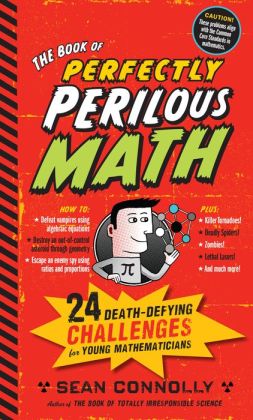
Another one of my favorite books that I just discovered last school year is The Book of Perfectly Perilous Math by Sean Connolly.  In this book, Connolly sets up various scenarios in which the reader MUST use math to save themselves from some tragic demise (attack by possessed robot, sucked bloodless by vampires...you know, the usual).  This is not a traditional picture book, although it does contain images, and is better suited for intermediate and middle grade students.  Because I then have my students solve these scenarios in groups, I usually save these for Fridays when I may be able to afford a little more than five minutes of time for the activity.

There are a plethora of math-related books out there, as well as a ton of internet-based sources, that can work for read-alouds the math classroom.  Take a look at the GoodReads "math picture books" shelf for some more ideas.  Scholastic also has a helpful web resource for those of you interested in teaching math with picture books.

Do you have other ideas for integrating reading and writing into the math classroom?  We would love to hear your ideas!

Thursday, July 17, 2014

Henry Ford Would Be Proud--Using QR Codes


In Front of the Museum Entrance
Going along with the theme of writing about our experiences from Meg’s last blog post, my husband and I recently visited The Henry Ford Museum and Greenfield Village in Dearborn, Michigan.  I must admit, when my husband first mentioned his idea of visiting these two places, I was not very enthusiastic.  I was wrong!

For those of you not familiar with these two facilities, I learned that Henry Ford did a lot more then make the Ford automobile.  He was quite the collector! And, this is how the museum and village got their start.  When you visit the museum and village, you get to see Henry’s collection first hand.  He was an inventor and an innovative man, so he collected items from people who were also innovative such as Charles Lindbergh, Thomas Edison, Abraham Lincoln, and the list seriously could go on for a long, long time.

Noah Webster House
When I say collected items, I mean the village is full of structures he collected like the one room school house he attended or Noah Webster’s (creator of the dictionary) home.  Yes, I said home!  Henry Ford purchased the home, and had it brought to his Greenfield Village.  I could go on and on with the list of amazing things you can see when visiting the museum, which brings me to my next point.  You don’t have to go there to experience all the museum and village have to offer.

Let me begin by saying the docents were very friendly, helpful, and informative. I love to see people enthusiastic about their work.  It speaks to the type of environment the museum is trying to create.   Anyway, it was a docent who led us over to this “kiosk” to show us how The Henry Ford Museum has gone digital.

Using the Touch Screen to Access the Digital Collections
Standing in front of one these touch computer screens allows you access to the museum's digital collections.  What does that mean?  Every item on display has been photographed and written about and the information has been made accessible for you to take home through the use of a QR code.  You can use your phone to scan the QR code, or a docent can give you what looks like a credit card to use to scan the QR codes.  Once you've scanned the code, the information is sent to you for access at a later date from the comforts of your own home.

For example, as I was walking through the museum I spotted a display on camping trailers.  Being that I like camping, I took a stroll through the display.  I came across the trailer of Charles Lindbergh and his wife.  Cool!  However, all I could see was the outside of the trailer.  BORING!

I wanted to see the inside of the trailer Henry Ford gave to his friend Charles in 1942, so I walked over to the “kiosk” to look it up in the digital collections.  Of course it was on file!  If I had wanted to, I could have scanned the available QR code and had the information saved for later use.  If you click on the link below the image of Lindbergh, you will also notice that through searching using the key word “Lindbergh”, I also had access to other archives the museum owns related to Lindbergh.  In fact, the museum’s digital collection includes every item they own—this means items that may not be on public display.

Link Here for More Info
Of course you can also access the museum’s digital collection at home, and I do encourage you to take a look.  I plan to use their digital collections this year in my English class for inspiration on various writing topics.  I can see myself pulling up photos from the digital collection--think visual literacy.  Also, it would be a wonderful non-fiction reading resource.  I am thinking reluctant readers would enjoy perusing the images and reading the “short” blurbs of text that accompany the pictures as well (see link beneath Lindbergh image).  And, of course, this site can be used to support history curriculum and for research.

You will probably see more about my experience at The Henry Ford Museum in future blog posts.  Until then, have fun using the digital collections and teacher resources found on the museum’s website.

Look for the word Collections on the museum's homepage.

Note:  I put kiosk in quotes because the museum did not call or label the computers available in the museum as such.  It just seemed like the right word to fit for the purpose of describing the technology available.

Thursday, July 3, 2014

Experiences Worth Writing About

June 14, 2014
Old St. Patrick's Church, Chicago
The month of June was quite the whirlwind!  I know most teachers welcome the end of the school year with open arms, happy to have summer break stretched out before them with possibilities of relaxation and adventure. For me (Meg), summer break meant something a little different this year.  I got married on June 14 to the most wonderful man, and thus embarked upon a new journey called marriage.

Teachers, regardless of the subject we teach, know that learning starts with making connections to our own experiences, using our background knowledge to attempt to gain access to a greater understanding.  While I am new to this whole marriage thing, I have not doubt it will give me plenty of experiences to use as fodder for future learning.  Likewise, I know I will need to use what prior knowledge I already have to help me navigate the waters of marriage.

Although there are still six weeks of summer break remaining, I cannot help but think forward to the upcoming school year (call me crazy) and how I will start the year with my students. I want to begin by building rapport with my new kids, and what better way to do that than sharing important life stories with each other?  Within the first few days of school, I always engage my students in some type of "about me" activity to start building our classroom community.  I have taught many different subjects over the past eight years, so the actual activity itself has changed in order to make a connection with my content area.  This coming school year, I will be back in 6th grade after a two year stint teaching 8th grade algebra.  My incoming 6th graders won't know much about me given they are new to the school, and those with older siblings who may have known of me will not recognize the name "Mrs. Knapik".  I will certainly need to provide them with some background on me if they are to feel comfortable learning with me.  And since I will still be teaching math, we will likely write math stories about our summer adventures to help us get to know each other.  This can be done briefly by writing their stories as blog posts, or this can be done with more depth by creating digital stories.

Patara Elephant Farm
Chiang Mai, Thailand
Thai Baht and US Dollar
I adapted this math story idea from Char Forsten's Math Talk, or telling number stories from illustrations, in the elementary classroom.  My honeymoon to Thailand and Bali gave me plenty of opportunities to use math from understanding the exchange rate between the US Dollar and the Thai Baht or Indonesian Rupiah to learning about the life span and diet of the Asian elephant I took care of for the day when I visited an elephant farm in the hills outside of Chiang Mai.  I will be able to share my experiences with my students, and in doing so they will not only learn more about who I am, but they will also notice they have more background knowledge about math than they may have initially thought.

What kind of experiences will you have this summer that will be worth writing about when returning to school in the fall?

Saturday, May 24, 2014

Using a Blog as a Formative Assessment


As the school year comes to an end, I (Jamie) can’t help but be reflective.  I think one of the best things I did this year was to begin using a blog as a way to formatively assess my students.  In August, way back at the beginning of the school year, I was looking for an alternative to making students complete a journal write about their summer reading.  My school requires students to read one book from a preselected list of books to read over the summer.  We like to use this book as a way to rally around a common book and theme.  This year’s theme was choice.  We had planned on having the students write an essay/journal response about their summer read.   I was not in love with the journal write idea because it meant that I, the teacher, would be the only one reading about their summer reading.  On the other hand, I didn't want to use precious class time to have students orally share their reading aloud to the class in a presentation format.  Blogging was my answer!  


In the past, I had used blogging as a way for students to write about their independent reading.  When doing this, I used Kidblog and each student owned their own blog.  Don’t get me wrong!  There is absolutely nothing wrong with using a blog in this way, but this year I went a different route.  The students were not going to own this blog. No, this blog would be owned by me.  This meant that I would supply students with prompts via a blog post, and they would respond by commenting to the blog post prompt.  This was a bit of a shift in thinking, and a move away from the traditional use of a blog.  But, it got the job done nicely!

I started this new blogging journey by creating a name for my blog.  You will have to admit that the name I created for my classroom blog was very original--Mrs. Diamond’s English Blog.  Well, I won’t score any points for originality with that name, but it got the job done.  I also decided to use Blogger to set-up my blog because all of my students have Google accounts through our school district, so this made sense for me.  There are other platforms such as Kidblog and Wordpress that you could choose to explore as well.

Within five minutes (maybe ten) of getting on to my computer, I had my blog up and running.  It really is not a difficult endeavor, and I encourage you to give it a whirl.  

Here was my first post given to my students:

Summer Read Blog Response - Choices
Matched by Ally Condie
Rules by Cynthia Lord
Crossing the Wire by Will Hobbs
Zach’s Lie by Roland Smith

Each of the summer read novels has a common theme of “choice”.  The main characters of each book make significant choices that direct the course of their lives and affect the lives around them.

TASK: Identify the significant choice the main character made and explain its impact on the story.  Include the following in your response:  
  • the title and author of your summer reading book
  • a brief summary of the plot
  • explain the significant choice he/she made
  • explain how his/her choice impacted others in the story
  • explain whether or not you agreed with the choice
  • explain how your opinion of the character and his/her choice shows who you are.
Begin your response by clicking on the comment button. Please include your first name, last initial, and your class period at the top of your comment.


This first blog post prompt was a success. I met both of my original goals. I was able to check-in on their summer reading, and I allowed students an opportunity to share their thinking/thoughts with others. The blog served as a formative assessment to obtain baseline data on my students reading comprehension as well as their writing abilities.

However, this blog post went well beyond my two goals.  Because it was a published piece of writing online, students took more time and put more effort forth in making sure their writing was of good quality.  They didn't want to be embarrassed in front of their peers.  Students were told that their writing was being shared with the entire team as well.  Instead of only being read by the twenty plus students in each of their classes, all 110 students on my team would have access to their thoughts. I loved the opportunity this provided for students to communicate with each other outside the classroom walls and class periods.  

As the year progressed, I found even more ways to use Mrs. Diamond’s English Blog.  While we read The Giver by Lois Lowry, I posted prompts that gave students the opportunity to interact with the text and with each other through the blog.  

Example:

The Great Escape

After learning that Gabriel is to be released the next morning, Jonas realizes he must escape from his community with him as soon as possible.  Imagine you are Jonas.  Explain why you are running away from the community.  Describe your planned destination.  Tell what you hope to find in this new place and what your plans are for your future.  

I also used the blog to check-in on their independent reading during reader’s workshop.  During reader’s workshop, students choose books on individual interest and preference.  Blogging through the use of prompts, helped me to keep a running record of the books each student was reading.  It allowed me to zero in on student who needed more support with their reading and alerted me to students who were not reading at all. Formative assessment!   I was also able to conference with students through the blog. To be honest, this was the first year that I felt like I was really able to keep up with student conferencing because I was able to have conversations with my students outside the school day via the blog.


If you’re interested in more information about blogging and uses for it in your classroom, check-out our book Literacy Lessons for a Digital World.  You’ll also find information on digital storytelling, podcasting, and collaborative websites.

Thursday, February 27, 2014

The Olympics: A Golden Opportunity for Literacy in a Math Classroom

I am a unique breed: current eighth grade algebra teacher and veteran sixth grade math, reading, language arts, and science teacher.  Being such, I have a perspective as an algebra teacher that is a bit different from my colleagues who come from a more traditional math-focused background.  As many teachers are now aware, the Common Core State Standards emphasize that all teachers should integrate literacy activities into their content areas.  In math specifically, the Standards for Mathematical Practices provide the perfect opportunity for this.  Gone are the days of simple math computations; instead students must construct viable arguments for their solutions and justify their problem solving process.  The math/reading/writing teacher combo in me just loves this!  However, to many math teachers, this can be a very intimidating task.

I have been fortunate to have the opportunity to work with two educational consultants this year, ReLeah Lent and Katherine McKnight.  These ladies are right there with me as huge proponents of integrating literacy into all content areas.  Our conversations have revolved around the merits of having students read articles related to math and write about their opinions, as well as using mathematical computations to argue a point in response to a controversial question.

Cue the 2014 winter Olympics in Sochi, and you have the perfect opportunity for students to read, write, and talk math.  Olympic.orgUSA Today, Live Science, and the New York Times among many others were great places to find graphs, infographics, and articles related to the Olympics.

There is so much math to be done!  Students can find measures of central tendency for race results, and more importantly, argue which is the most accurate representation of the data (and why they believe so!). Using these resources, students can look at preliminary runs and calculate probabilities of various athletes taking home the gold, or they can determine whether or not the Olympics provide a "fair" opportunity for a variety of athletes to participate.
They can convert the cost of tickets to the closing ceremonies from Russian rubles to US dollars, compare this to the cost of other Olympic game events, create a travel itinerary, and create a persuasive argument as to why we should have taken (or not) a school-wide trip to the Olympic games.  (Add a fundraising component onto this field trip idea, and that makes it all the more exciting!)  I also had my kids participate in a Fantasy Olympic league to further spread the "Olympic fever".  (Don't worry, there was no money exchanged over the course of the Olympics, only cute hand-made certificates to the winners.)  Again, there were multiple opportunities to talk about probability, measures of central tendency, and graphical representations of the teams' progress.

While the Olympics provided a perfect backdrop to immerse my students in authentic math tasks while also incorporating literacy into my classroom, I was reminded that I can do this kind of stuff any time!  Yes, these types of activities require time in preparation as well as in class.  And, I do admit that from time to time, the literacy activities I use with my kids may stray from the curriculum standards so many of us fear we won't be able to squeeze in over the course of the school year.  However, in my humble opinion my students are getting a well-rounded and meaningful mathematical experience.  I am creating an environment in which talking about and doing math is valued.  Students are learning to use math to their advantage to draw conclusions, and they are becoming more articulate in explaining their thought process and reasoning.  Most importantly, I am coaching these kids to become problem solvers who use all of their resources and persevere through difficult situations.  THESE are the qualities that will stick with kids for the rest of their lives.  And while I do teach my students a quadratic equations song that they still sing years later when they come back to visit me, I know it is the former skills that serve them well in their day-to-day lives.

Saturday, February 8, 2014

Looking for Inspiration and New Ideas to Teach Inferencing

Hot cup of coffee brewed and an apple danish acquired from my local bakery, my mission this morning is to surf the web in search of ways to help my students with inferencing. The amount of materials available through a simple web search never ceases to amaze me, and I love when I have a few moments to discover new ideas to incorporate into my lesson planning. 

My first discovery was a blog called Technology up to Speed (add this one to your favorites).  I have included the link for the post dated August 6, 2013, so you don't have to search out the materials I am about to discuss. Once you find yourself on the post, you will find a link to animated short videos and a link to free graphic organizers to use in conjunction with the videos to teach various reading skills.  The materials offered on the post are organized by the skill you are interested in teaching, which makes it very user friendly.  You are also able to download the materials for future use.  The video shorts are also accessible via YouTube.  Of course, my focus was on finding materials to teach inferencing skills, so I spent most of my  time perusing those videos and organizers, but there were other topics covered.  You will  find links to help you teach cause and effect, compare and contrast, questioning, predicting, and many others.   If your looking for a way to engage your students and teach reading skills, this is a great place to start.


Next, I found myself on site called Haiku Deck. This site offers educators an alternative to using Powerpoint and/or a Google presentation. It allows you and/or your students to combine text and images to share information in a user friendly format without being overwhelmed by having to make too many formatting decisions. The site offers both an iPad app or web app as a free download.  The Haiku Deck also offers educators plenty of information and inspiration to get you started--click here for more information/help.  

After creating my Haiku Deck account and exploring the site a bit,  I came up with the idea of using it to make Inference Riddles.  Feel free to take a look at my example, and use it in your own classroom.  My plan is to show students my riddle, and then they will work on creating their own riddles.  I think this is a great way to help students to understand the importance of using textual clues as well as using imagery to help their peers guess the answer to their own riddle.  They will be practicing their abilities to make inferences and not even know it!

Danish gone as well as two cups of coffee!  


 on their abilities to use implicit and explicit evidence inference making skills