Friday, September 5, 2014

Our Classrooms: A Work in Progress

Blogging Challenge Day 5:

Post a pic of your classroom, and describe what you see--and what you don't see that you'd like to.
Mrs. Diamond's classroom
 Jamie-
I see a classroom in the early stages of development. It is after all the beginning of the school year--right? There isn't a ton hanging on the walls, but there is a reason for this.  I am not one of those teachers who builds the classroom for my students.  I like to build my classroom with my students.  For example, the yellow square on my backboard is my word wall  that a student in my class helped me build.  The faint sketch of two stick people are examples of me and my co-teacher writing with our students during a brainstorming sessions to generate a list of things of interest to us.  In the second picture you can see my classroom door is filled with "Tweets" my students created about their reading over Labor Day weekend.  I also see books, and places for my students to get comfy and read.  Now for what I don't see!  I don't see a room that is set-up for easy collaboration amongst my students.  I also don't see a room that is user-friendly for technology.  By this I mean, I'd like to have charging stations for my students to easily charge their Netbooks.  One last thing I don't see is a place for me to keep things in storage.  I hate that there is a huge pile of boxes back in the corner of my room cluttering up my classroom library.  I'd like to find a way to organize this and get that stuff out of sight.  And, true confessions time...my desk area is always kind of a mess--organized chaos.
Meg-
Mrs. Knapik's classroom
Welcome to my sixth grade math classroom! What I see when I walk in the room is an inviting space full of color and math-related resources. From the place value poster above the dry-erase board to the math Word Wall, I want my students to be immersed in math when they enter my room. I also see a space that values literacy. Despite the fact that this is a math classroom, I have a class library and reading area where my "Hot Reads" is displayed, and our Word Wall highlights math vocabulary. I also see a variety of resources to help students be more self-sufficient learners, like the class calendar with daily homework assignments, a supply station for students who may have forgotten something (no more wasting time to get a pencil from a locker!), and the objectives posted on the dry erase board. Collaboration is also valued in my classroom since, for the first time, I have ditched the separate desks and am trying out tables. What is still missing from my classroom is an abundance of displayed student work. While I do have some student-created vocabulary posters posted on the Word Wall, you can see the red bulletin board is still empty (and as much as I would like to claim credit, the student maps hanging from the ceiling are from the Social Studies teacher who shares my room). The student work will come as we look to wrap up our first unit in a few weeks, so stay tuned...

Teachers, what are your favorite features of your own classroom?  Anything your classroom is still missing?

Wednesday, September 3, 2014

Love the Most

Blogging Challenge Day 4

What do you love the most about teaching?

Jamie-The single best thing about teaching is absolutely having the privilege of working with middle school students each and every day.  I love to grow readers and writers in my classroom.  There is no better feeling in the world then making a student believe in themselves.  Every year I tell my students how I was once a reluctant reader and how I found reading to be very difficult.  Then I explain that each year is a fresh start, and if they allow me, I can help them to discover the path to being a reader (and writer, too).  I am a big fan of Nancy Atwell and use many of her teaching strategies from The Reading Zone.  Early in the school year, I tell students that they can read any book of their choice for independent reading--no worry about Lexile level.  Students should read voraciously books of their choosing.  I allow students to re-read favorites from past years.  Also, I tell students they can skip pages or chapters if their not into the book.  We discuss how to abandon books, and how to choose the "right" books.  My students and I talk about books like most people talk about television shows and movies.  We write book reviews, produce book trailers, and record podcasts about what we are reading.  At the end of the year, I love the satisfaction of seeing their faces when they self-evaluate their reading by totaling up the number of books and pages read.  Smiles all around! I know I don't change the minds of all, but I do know they leave my class having enjoyed reading at least a little bit more...at least that is what my students have told me over the years in their exit letters to me. 

Meg- Like Jamie, what I love about teaching is the enthusiasm, quirks, and antics of my middle school students.  Not a day goes by in my classroom that I don't laugh with at least one (and usually many more) students, and I generally have hilarious anecdotes to share with my husband every night.  I still remember clearly the student in my first year of teaching who asked to go to the bathroom, and when I looked up at him I saw he had drawn cat whiskers on himself in Sharpie marker.  This year one of my most enjoyable students may be the one who, upon going through role call on the first day of school, requested I call him "the doctor" in a very thick British accent (and no, he wasn't actually British).  I often think I should write my own version of Chicken Soup for the Teacher's Soul as an anthology of all my favorite middle school student encounters.  While we know teaching critical thinking and problem solving skills are important, the relationships we form with our students are of equal importance to their confidence and social-emotional health.  The kids are the ones who help me remember this each and every day.

Teacher Evaluation Goal

Day 3 Blogging Challenge:

Discuss one "observation" area that you would like to improve on for your teacher evaluation.

Jamie-
One goal I have this year, connected to our district's teacher evaluation rubric,
is found under the Professional Responsibilities Domain. I would like to work on increasing the amount of communication I have with parents. I believe I do a good job of posting grades on our web-based grading system, I keep up with my website, and email parents when students are struggling academically or emotionally.  However, I want to get better at sending home positive email/notes to parents when their child is doing well. I used to do this when I taught 6th grade, and I got away from it when I moved up a grade to teach 7th grade English.
I think it is important to celebrate the positives.
Also, I would like to be more consistent about sending home "homework alerts" via email before a big assignment/assessment might be due.  I know that parents have busy schedules, and they might appreciate a quick email alert instead of having to check my website. Hmm...maybe I could even use Twitter?

Meg-
As I mentioned in our first post of the 30 day teacher challenge, one of my goals is to put structures in place to help my sixth graders become more self-sufficient. This also means I need to help students become better at self-monitoring their progress. I have grown leaps and bounds in the realm of using formative assessment over the course of my teaching career as a means for informing my instruction and interventions. However, when I recently read chapter one from the book Advancing Formative Assessment by Susan M. Brookhart and Connie M. Moss I was immediately struck with a realization that I don't put as much emphasis on creating a partnership with my students in these formative assessments. One of the goals on our observation rubric refers to helping our students be self-directed learners. By creating a partnership mentality with my students throughout all formative assessments, they will become more aware of their progress and hopefully more motivated to continue to improve.

Tuesday, September 2, 2014

New EdTech Goodies

Day two in the 30 day teacher blogging challenge:

Write about one piece of technology that you would like to try this year, and why. You might also write about what you’re hoping to see out of this edtech integration.

Meg - My sixth grade students are piloting iPads this year, yippee!  This truly is exciting, but as much as I consider myself pretty edtech savvy, I really do not have a lot of experiences with iPad apps for education because, well, my students have never had iPads to use before.  I hope to learn about a plethora of iPad apps that I can have my students use to share their learning with me, their peers, and the world.  I have already created a new YouTube channel for my class with the hopes that we will have a bunch of helpful math videos to upload and share with the world.
Jamie - As I start the year, I would like to try using QR codes.  My English students currently create book reviews and/or book advertisements by making podcasts, book trailers, and print ads, so I was thinking it would be fun to use QR codes in conjunction with my classroom library. When students are perusing my library looking for their next book to read, they would be able to use the QR codes to listen, view, and/or read other students' recommendations.  I love that QR codes provide me with an authentic audience for my students and help me to build a community of readers. Can't wait to give this a try!


Monday, September 1, 2014

Challenge Accepted: the 30 Day Teacher Blogging Challenge


Taking the Challenge! Meg and I have decided to take the 30 Day Blogging Challenge posted by Te@chThought.com.  The challenge asks teachers to blog during the 30 days of September with the goal of becoming a more reflective teacher.  Each day a prompt is given to guide you in the blogging process.  It can’t get any easier than that, right?  So,  see the link below and join us in this great opportunity to become better at our craft--teaching!.


Day 1 of the challenge:

Write your goals for the school year. Be as specific or abstract as you’d like to be!
Jamie-As I start my 21st year in the classroom, I continue to struggle with implementing the readers and writers workshop philosophy into my middle school English classroom.  Trying to fit time to teach mini-lessons, for students to write, and me to conference all in a 45 minute class period can be very difficult.   It is also very hard to maintain conferences over 5 class periods with over a 100 students. So, this is definitely something I am working on improving.  Secondly, I want to work on being more consistent in maintaining my word wall.  I always start off strong, and then by mid-year I taper off. One last goal would be to also work on maintaining my “Bell Ringers”.  I love to have something for students to complete as they enter my classroom.  However, once again, I start the year off strong with fun and interesting prompts, and then it somehow dwindles.  If I could improve on these three things, it would be quite an accomplishments.  Here’s to another year of trying!

Meg-I have transitioned back to teaching sixth grade this year, and in just the two short years of teaching eighth grade it was easy for me to forget how many differences there are between these two ages of students! In light of this, one of my goals is to provide structures for my sixth grade students that will promote self-sufficiency. In order to do that, I am attempting to use my class website a bit differently this year than I have in the past. The sixth graders are piloting iPads, and I want them to use these iPads to help them self-start at the beginning of class. As a part of our daily routine, I am having the students first go to my class website on their iPad where they will find the supplies needed for class, the essential questions for the day, directions for stations (if we are doing stations that day in class), as well as the homework assignment for the night. Hopefully this will be a helpful resource that will support students in being more self sufficient. Another goal of mine, similar to Jamie's, is maintaining consistency with using a math workshop approach in my classroom. Although it may not be something I use every day, I do want to use this model on a regular basis to provide a good balance of instruction, remediation, and independent work time that is more tailored to the needs of each student.

Thursday, August 14, 2014

It's Story Time in Math Class!

Jamie & me at my wedding!
This has been an exciting summer for the both of us to say the least.  The weeks have flown by, overflowing with vacations, weddings, gatherings with friends and family, and teaching our beloved MLIT students at Judson University.  And, believe it or not, we also found some time to attend a few professional conferences!

My "hot read" in my classroom
If you have read our blog before, you know that I (Meg) am currently a math teacher, although for the first six years of my teaching career I also taught reading (as well as four years of language arts).  I do love teaching math, but it broke my heart to give up teaching reading.  Luckily, I realized I didn't have to stop being a literacy teacher even though I no longer had the official title.  The  Common Core State Standards call all teachers, regardless of their content area, to include literacy activities in their classroom.  I rejoiced when I realized I did not have to give up read-alouds, my "hot reads" grill, or my classroom library!  My students would still be able to blog, podcast, and write creative stories!  The only difference is the focus of the reading and writing activities would have to shift a bit to incorporate math.

One of the easiest ways to incorporate literacy into a math classroom is via read-alouds.  Particularly at the beginning of the school year, I think this is a great way to engage students.  Kids of all ages (heck, adults too!) enjoy being read to, so setting aside about five minutes of class time for a read-aloud has become a routine in my math classroom.  The read aloud can come from a picture book, a novel, a magazine article, a blog post...the options are endless!

To start the year, both as a sixth and eighth grade teacher, I read the book The Math Curse by Jon Scieszka.  Scieszka is a hilarious author, and in this book he tells the tale of a young man who thinks his teacher put a math curse on him because he ends up seeing math in EVERYTHING.  This book is a math teacher's dream because we are always trying to convince our students how useful math is outside the math classroom.  Following the book reading, I have my students write short math stories of their own about a time they were struck with the "math curse" over the summer.  Since this is at the beginning of the school year, the purpose of the activity is to get their brains thinking mathematically again, not necessarily to connect to a specific topic of study.  Some students write about using math on a vacation, some write about using math when keeping score at a sporting event, and one time a student calculated the approximate number of minutes she thought she spent FaceTiming with her friend.  Whatever the topic, this is a great introductory activity to get students reading and writing about math.

Hanging out with Greg Tang!
One of my favorite authors whose books I use many times throughout the year is Greg Tang.  If you have never seen Greg Tang speak, you simply MUST!  He has a wonderfully dry sense of humor that always has the room of teachers roaring in laughter.  I have seen him speak multiple times, but this summer I got to meet him...and actually talk to him, meaning I had a real conversation with him!  I composed myself enough to sound intelligent as we talked about teaching mathematics, but truth be told, my inner self was screaming, "I can't believe I'm talking to Greg Tang!"  Anyway, Greg Tang's books are full of ways to make math easier by encouraging students to look for patterns.  The Grapes of Math is probably Tang's most well-known picture book, but he has many!  And the best part is that they are all animated and available to read for FREE on Greg Tang's website.  For some great ideas on using Greg Tang's book with math journal writing, check out one of my graduate student's blogs.

David Schwartz is another go-to author for math picture books.  G is for Googl is a wonderful resource to keep on hand for read-alouds related to math vocabulary.  For each letter of the alphabet Schwartz provides a definition of a math term in "kid-friendly" words, as well as an accompanying visual.  From time to time, I start my class by reading a page in the book of a math term related the day's lesson.  I then do a quick follow-up activity to have students either create a motion that will help them remember the meaning of the word (we know from brain research that physical activity spurs memory) or draw a picture in the back of their math journal with the word and definition (the back of their math journal is where my students keep their own personal glossary of math terms, in addition to our class word wall, so they have access to the math vocabulary words outside of school as well).

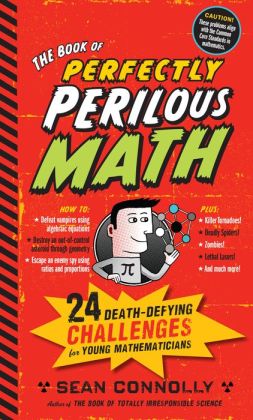
Another one of my favorite books that I just discovered last school year is The Book of Perfectly Perilous Math by Sean Connolly.  In this book, Connolly sets up various scenarios in which the reader MUST use math to save themselves from some tragic demise (attack by possessed robot, sucked bloodless by vampires...you know, the usual).  This is not a traditional picture book, although it does contain images, and is better suited for intermediate and middle grade students.  Because I then have my students solve these scenarios in groups, I usually save these for Fridays when I may be able to afford a little more than five minutes of time for the activity.

There are a plethora of math-related books out there, as well as a ton of internet-based sources, that can work for read-alouds the math classroom.  Take a look at the GoodReads "math picture books" shelf for some more ideas.  Scholastic also has a helpful web resource for those of you interested in teaching math with picture books.

Do you have other ideas for integrating reading and writing into the math classroom?  We would love to hear your ideas!

Thursday, July 17, 2014

Henry Ford Would Be Proud--Using QR Codes


In Front of the Museum Entrance
Going along with the theme of writing about our experiences from Meg’s last blog post, my husband and I recently visited The Henry Ford Museum and Greenfield Village in Dearborn, Michigan.  I must admit, when my husband first mentioned his idea of visiting these two places, I was not very enthusiastic.  I was wrong!

For those of you not familiar with these two facilities, I learned that Henry Ford did a lot more then make the Ford automobile.  He was quite the collector! And, this is how the museum and village got their start.  When you visit the museum and village, you get to see Henry’s collection first hand.  He was an inventor and an innovative man, so he collected items from people who were also innovative such as Charles Lindbergh, Thomas Edison, Abraham Lincoln, and the list seriously could go on for a long, long time.

Noah Webster House
When I say collected items, I mean the village is full of structures he collected like the one room school house he attended or Noah Webster’s (creator of the dictionary) home.  Yes, I said home!  Henry Ford purchased the home, and had it brought to his Greenfield Village.  I could go on and on with the list of amazing things you can see when visiting the museum, which brings me to my next point.  You don’t have to go there to experience all the museum and village have to offer.

Let me begin by saying the docents were very friendly, helpful, and informative. I love to see people enthusiastic about their work.  It speaks to the type of environment the museum is trying to create.   Anyway, it was a docent who led us over to this “kiosk” to show us how The Henry Ford Museum has gone digital.

Using the Touch Screen to Access the Digital Collections
Standing in front of one these touch computer screens allows you access to the museum's digital collections.  What does that mean?  Every item on display has been photographed and written about and the information has been made accessible for you to take home through the use of a QR code.  You can use your phone to scan the QR code, or a docent can give you what looks like a credit card to use to scan the QR codes.  Once you've scanned the code, the information is sent to you for access at a later date from the comforts of your own home.

For example, as I was walking through the museum I spotted a display on camping trailers.  Being that I like camping, I took a stroll through the display.  I came across the trailer of Charles Lindbergh and his wife.  Cool!  However, all I could see was the outside of the trailer.  BORING!

I wanted to see the inside of the trailer Henry Ford gave to his friend Charles in 1942, so I walked over to the “kiosk” to look it up in the digital collections.  Of course it was on file!  If I had wanted to, I could have scanned the available QR code and had the information saved for later use.  If you click on the link below the image of Lindbergh, you will also notice that through searching using the key word “Lindbergh”, I also had access to other archives the museum owns related to Lindbergh.  In fact, the museum’s digital collection includes every item they own—this means items that may not be on public display.

Link Here for More Info
Of course you can also access the museum’s digital collection at home, and I do encourage you to take a look.  I plan to use their digital collections this year in my English class for inspiration on various writing topics.  I can see myself pulling up photos from the digital collection--think visual literacy.  Also, it would be a wonderful non-fiction reading resource.  I am thinking reluctant readers would enjoy perusing the images and reading the “short” blurbs of text that accompany the pictures as well (see link beneath Lindbergh image).  And, of course, this site can be used to support history curriculum and for research.

You will probably see more about my experience at The Henry Ford Museum in future blog posts.  Until then, have fun using the digital collections and teacher resources found on the museum’s website.

Look for the word Collections on the museum's homepage.

Note:  I put kiosk in quotes because the museum did not call or label the computers available in the museum as such.  It just seemed like the right word to fit for the purpose of describing the technology available.